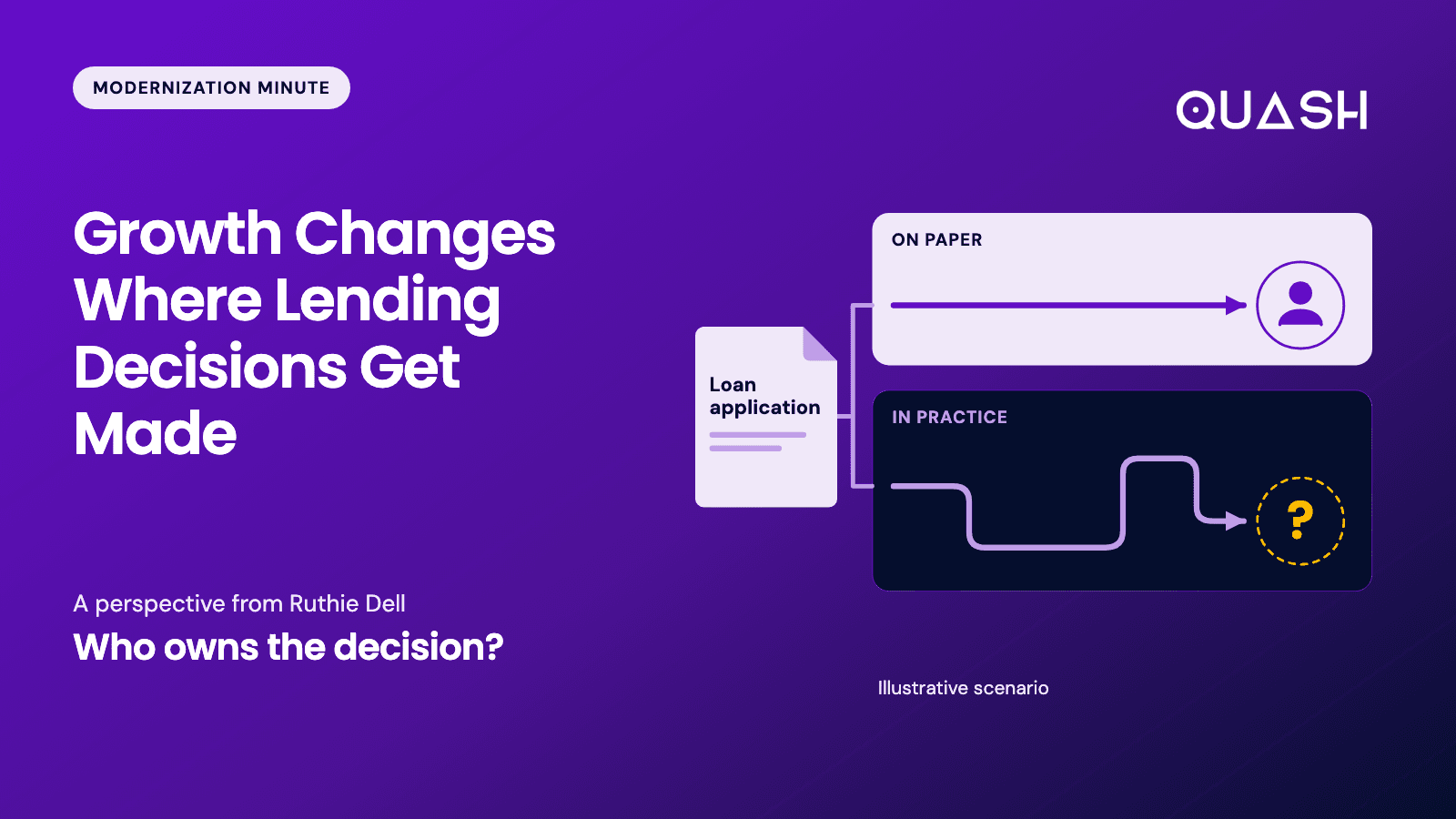
When Two Lending Philosophies Become One
October 21, 2026

At the end of the second quarter of 2026, there were 4,214 federally insured credit unions.
One year earlier, there were 4,370.
That’s 156 fewer institutions in twelve months, and consolidation continues to be one of the steady forces reshaping the industry.
Most of the attention in a merger goes, understandably, to the big pieces: the balance sheet, the core system, the brand, the members, the staff.
But behind each combination are also two lending operations that grew up separately.
- Different credit policies.
- Different exception practices.
- Different overlays, review thresholds and product structures.
- Different approaches to manual review.
- Sometimes, different ideas of what a “good file” looks like.
Combining balance sheets happens on a legal date.
Combining lending philosophies usually takes longer.
And the choices made during that process can shape the combined organization’s lending for years.
In practice, those choices are often made under time pressure.
Systems need to be converted. Policies need to be consolidated. Teams need clear guidance on day one.
So it’s natural for one institution’s credit policy to become the starting point, often the larger institution’s, with adjustments made along the way.
That can be a perfectly sound approach.
But it can also mean that some of what worked well at the other institution quietly disappears, without anyone deciding it should.
That’s where a few questions can help:
- Where do the two credit policies actually differ, and where do they only look different on paper?
- How did each institution’s approvals, declines and exceptions perform historically?
- Would applicants approved at one institution have been declined at the other, and how did those loans perform?
- Did one institution serve a population, product or market particularly well, and why?
- Which practices should carry forward, based on evidence rather than on which institution was larger?
Merged institutions have something unusual to work with: two sets of historical decisions, often on similar borrowers, made under different rules.
That’s a natural basis for comparison.
It’s rare to have a built-in way to see how different lending approaches played out on comparable populations. A merger can provide exactly that.
The analysis may confirm that one approach should simply carry forward.
It may show that each institution got something right.
Or it may surface a question neither institution would have asked on its own.
None of that requires slowing down the integration.
It simply means letting the evidence inform the policy decisions that have to be made anyway.
A merger combines two lending histories. Those histories can help decide what the combined organization’s lending should look like.
That’s your Modernization Minute.

Ruthie Dell
Chief Lending Modernization Officer
Ruthie Dell is Chief Lending Modernization Officer at Quash, where she helps financial institutions use their historical lending data to make more informed policy decisions. She is especially interested in moments of organizational change, like mergers, when two lending histories offer a rare chance to compare different approaches and let the evidence guide what carries forward.