
Growth Changes Where Lending Decisions Get Made
October 28, 2026
According to NCUA, federally insured credit unions served 146.1 million members in the second quarter of 2026.
They did it with 156 fewer institutions than a year earlier.
By my math, that works out to roughly 34,700 members per credit union, up from about 32,900 one year earlier, an increase of about 5%.
Fewer institutions. More members each.
Growth like that shows up in a lot of places: more applications, more channels, more locations, more people involved in each lending decision.
And it tends to raise a familiar organizational question:
Where should lending decisions be made?
Some institutions centralize underwriting for consistency and efficiency.
Others keep decisions closer to branches and the member relationships built there.
Many land somewhere in between, with certain products, loan amounts or credit tiers handled centrally and others decided locally.
None of these models is inherently right.
Each carries tradeoffs.
Centralization can strengthen consistency and make it easier to apply policy the same way across the organization. But it may move decisions further from local context, and from the relationship a member has with the people who know them.
Distributed decisioning keeps that context close. But it can make similar applications harder to evaluate the same way across locations, and harder to monitor as a whole.
And a hybrid model brings its own question: how cleanly do files move between the two?
What makes this especially worth revisiting is that decision structures rarely get redesigned all at once.
They tend to evolve.
A referral threshold gets added here. A product moves to central review there. A new channel launches with its own process.
Each change makes sense on its own.
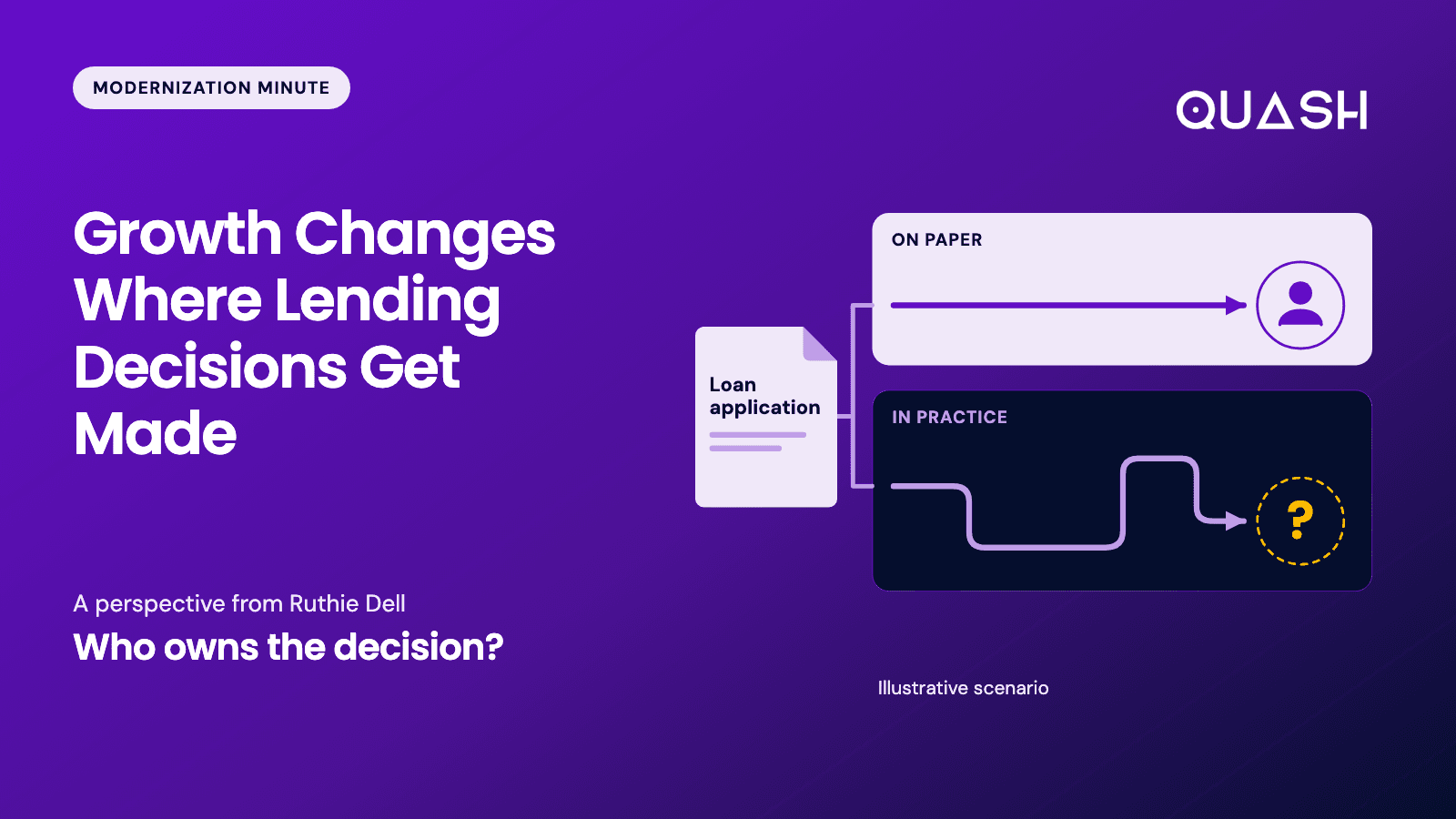
But over time, the way decisions actually flow can drift away from the way the organization thinks they flow.
A few questions worth asking:
- Do similar applications receive similar outcomes, regardless of where or how they’re submitted?
- Where do files get referred or escalated, and how long do they wait?
- What context is available to the person making the decision, and what gets lost when a file changes hands?
- Who owns the decision once it’s referred?
- Are referral and escalation thresholds still aligned with the risk they were designed to manage?
The answers may reinforce the structure you have today.
Or they may show where growth has quietly changed how decisions actually flow.
Either way, it’s easier to make a deliberate choice about decision structure when you can see how the current one is performing.
As a lending organization grows, where a decision gets made can shape it as much as who makes it.
That’s your Modernization Minute.

Ruthie Dell
Chief Lending Modernization Officer
Ruthie Dell is Chief Lending Modernization Officer at Quash, where she works alongside lending executives to understand how decisions actually flow through their organizations. With a background spanning financial technology, market research, public relations and operations, she brings a practical, operations-minded perspective to how lending structures can evolve as institutions grow.