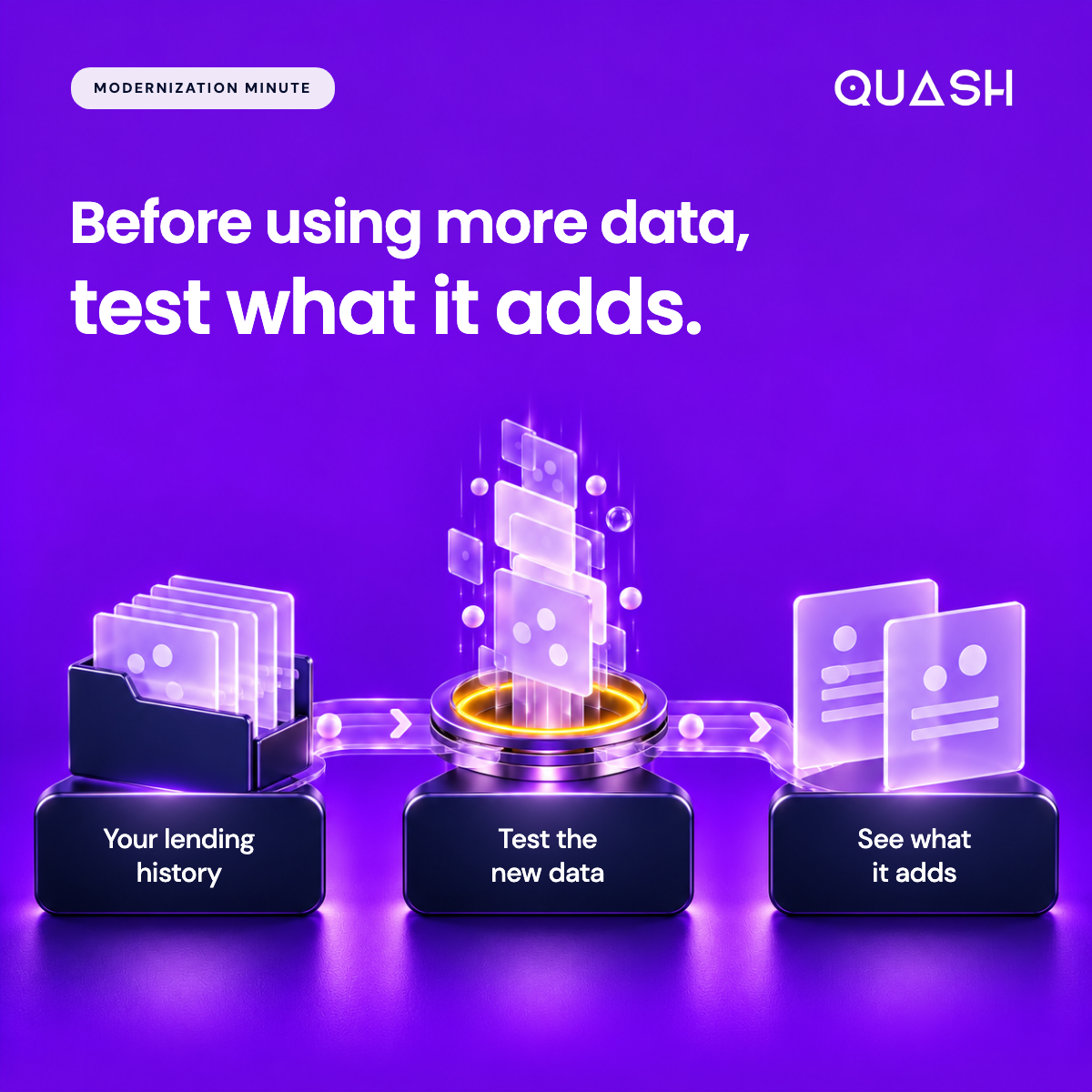
Before You Use More Data, Ask Whether It Adds Anything
Modernization Minute | Quash
Alternative data can create some interesting possibilities in lending.
But there's a step between finding a new source of information and deciding it's useful:
Validation.
The question isn't simply whether a new source of data exists.
It's whether that information provides meaningful additional insight in a particular lending environment.
And one way to explore that question is historically.
Take a population where the outcome is already known.
Apply the additional information without using that outcome to influence the analysis.
Then compare.
Did the additional information show meaningful differentiation?
For which populations?
Did it tell you something you didn't already know?
Where did it add little or no additional insight?
Those questions matter just as much as finding a positive result.
That's the philosophy behind the blind validation work we're doing with the Global Inclusion Score.
The lender retains the underlying performance outcomes, while Quash evaluates the historical population using the information needed to generate the Global Inclusion Score.
Then the lender can evaluate the results against its own outcomes.
That means we're not starting with the assumption that the Global Inclusion Score will uncover an opportunity.
We're testing whether it does.
And I think that's a useful principle well beyond alternative data:
Before you build a strategy around a new source of information, find out what it actually adds.
That’s your Modernization Minute.
Want to go deeper? Our new executive guide, From Insight to Strategy, explores how lenders can move from topline metrics to deeper analysis, identify questions worth investigating and validate new information before determining what, if anything, should change.

.svg)