The Shift Toward Predictive Decisioning
A Lending Modernization Perspective
Over the past few weeks, we've explored how lending is changing.
Traditional credit data remains one of the strongest foundations in underwriting—but it doesn't always tell the complete borrower story.
We've discussed how static rules, while essential for governance and consistency, are increasingly being asked to evaluate borrowers whose financial lives don't always fit neatly into predefined decision frameworks.
And last week, we looked at how predictive intelligence can help provide additional borrower insight by combining traditional credit data with digital identity, digital footprint, and other predictive signals.
The natural next question is:
Now what?
Because identifying additional borrower intelligence is only valuable if institutions know how to use it.
That's where predictive decisioning comes in.
Contrary to what the name suggests, predictive decisioning isn't about allowing technology to make lending decisions on behalf of an institution.
It's about giving lending organizations the ability to consistently incorporate better borrower intelligence into the decisions they're already making.
Think about a typical lending policy.
It reflects years of experience.
Board-approved risk appetite.
Regulatory expectations.
Portfolio performance.
Institutional philosophy.
Those policies shouldn't disappear simply because new borrower intelligence becomes available.
They should become stronger.
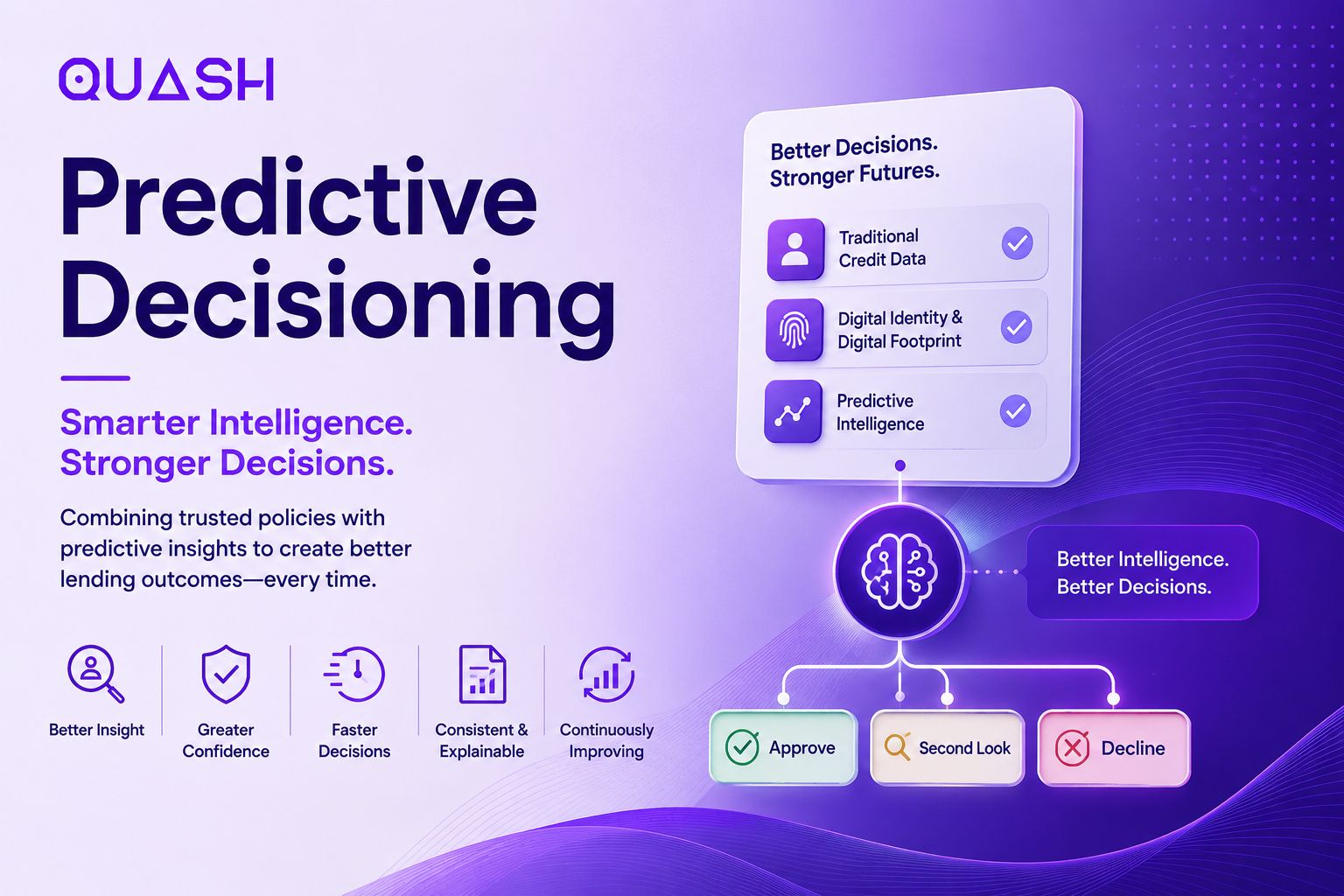
Predictive decisioning allows institutions to combine trusted underwriting policies with broader borrower intelligence, creating lending environments capable of making decisions that are not only faster—but more consistent, explainable, and adaptable.
Rather than relying solely on fixed thresholds or static decision pathways, predictive decisioning introduces additional context into the process.
That context can help lending teams:
- identify borrowers who deserve a second look despite falling outside traditional approval criteria;
- reinforce approvals that may have otherwise required manual review;
- validate declines with greater confidence;
- reduce unnecessary interpretation variance across underwriting teams; and
- continuously evaluate how lending policy performs as borrower behavior and portfolio characteristics evolve.
Importantly, none of this removes the underwriter from the process.
It simply gives the underwriter—and the institution—better intelligence to support the decisions they already own.
This is where many financial institutions are beginning to shift their thinking.
The conversation is no longer, "Should we use AI?"
It's becoming, "How do we make every lending decision as informed, consistent, and explainable as possible?"
That's a very different question.
And it's one that reflects the future of responsible lending.
Because predictive decisioning isn't about replacing governance.
It's about giving governance better intelligence.
It isn't about replacing policy.
It's about helping policy adapt as borrower behavior evolves.
And it isn't about approving more loans for the sake of growth.
It's about ensuring every lending decision—whether it's an approval, a decline, or a second look—is made using the fullest understanding of the borrower available.
The institutions that will lead the next generation of lending won't simply have better models.
They'll have better decisioning.


.svg)